
The Allure of Gloss Finishes for Vehicles
Aesthetic Impact and Curb Appeal
Standing in a Cape Town parking lot, the cars that draw your eye are often wrapped in gloss. That vibrant shine comes from a high-gloss polymer film. Gloss vinyl wrap Cape Town professionals apply a top coat that reflects light evenly, producing a surface with intense colour saturation. The car appears freshly detailed, even after weeks on the road.
Choosing gloss vinyl wrap Cape Town also changes how others perceive your vehicle. A glossy exterior signals careful maintenance, which raises perceived value. For private owners and businesses, a wrapped car becomes a mobile statement. The smooth film resists minor scratches, keeping the finish clean.
Gloss finishes offer these practical benefits:
- enhanced depth of colour
- simpler cleaning due to non-porous film
- uniform gloss across body panels
From my experience, the aesthetic payoff is immediate! A glossy car in Cape Town’s bright light simply stands out, and that visual advantage boosts curb appeal.
Protection from Cape Town’s Climate
Cape Town’s sun beats down hard. Strong UV light fades original paint, and the sea breeze carries salt that settles on body panels. When you choose gloss vinyl wrap cape town, the film takes the damage that would otherwise reach the factory finish.
From my experience on coastal routes, the film handles wind-blown sand and stone chips from the motorway with ease. Once it has taken enough wear, a professional peels it away to reveal the paint beneath, still in good condition.
Protection covers:
- UV resistance that prevents colour fading
- A barrier against salt and coastal moisture
- Sacrificial coverage for chips and scratches
Resale Value and Customization
Every used car hides a story. The question is whether that story lifts the price or sinks it. A gloss vinyl wrap cape town installation writes a different ending. The film takes the scuffs, the stone chips, the salt-laden wind. When the day comes to sell, the wrap peels away and the factory paint emerges, untouched, as if the years never happened. Buyers notice. The asking price holds!
I have watched owners agonize over whether to modify their cars, worried about wrecking resale value. Wrap changes the calculation entirely. Owners switch colours, finishes, even textures, treating the car as a flexible asset. The beauty of vinyl is that none of it is permanent. One owner’s bold wrap becomes the next buyer’s surprise underneath. The flexibility reshapes how you approach customization.
Versatility of Colors and Effects
I have watched a gloss vinyl wrap cape town change a car’s personality in a single afternoon. The film reflects sunlight with a crispness that factory paint can’t reproduce. It delivers a polished, luminous surface that hides the car’s age. In this coastal city where light moves quickly, the gloss stays steady.
The palette offers a generous range. A high-gloss wrap can include:
- Pearlescent whites that shift with the sky
- Metallic gunmetal with deep reflectivity
- Full-saturation reds that hold at dusk
Each shade gives a different character, and the finish keeps that signature gloss. Because the film sits as a layer, the choice is reversible. A gloss vinyl wrap city frees the owner to follow a whim. That flexibility is the appeal!
Exploring Gloss Wrap Options and Materials
Cast vs. Calendered Vinyl Films
Most drivers assume every vinyl film is the same. That assumption costs money. The real split comes down to how the film is manufactured: cast versus calendered. For a gloss vinyl wrap cape town, this distinction decides how the wrap behaves on panels, curves, and over years of sun exposure.
Cast film is poured onto a liner and cured. It holds its shape under stress. It hugs complicated contours like bumpers and side mirrors without lifting. I have seen cast wraps outlast their owners’ patience. Calendered film is extruded and rolled flat. It is thinner and inevitably shrinks over time. It suits flat surfaces and short term projects.
The choice affects every expectation you carry:
– Cast film resists shrinking and cracking
– Calendered film costs less upfront
– Cast film works for full wraps
– Calendered film works for accents or trade vehicles
Your car deserves the honest answer to that split.
Premium Gloss Color Films
Gloss is a number, not a personality. The material behind that number decides if a gloss vinyl wrap cape town reflects traffic lights without smearing. Premium gloss colour films deserve scrutiny beyond the shine. Their face films use a polyurethane top layer with ceramic hardeners. That resists micro-scratches from sand.
- Face film thickness above 1.6 mil
- Low-ghosting adhesives that remove cleanly
- Urethane top coats with UV inhibitors
These details appear after a year of Table Mountain wind. I have seen cheap films turn milky in nine months. The premium stuff still holds its depth.
Metallic and Chrome Finishes
Most people think a gloss wrap stops at solid colour. It does not. Metallic and chrome finishes push into a different visual territory. Metallic films embed fine aluminium flakes within their layers, creating a shimmer that shifts with every curve. Chrome films use a vacuum metalised process to produce a mirror finish.
These materials are unforgiving.
- Metallic films reveal every fingerprint.
- Chrome surfaces highlight every panel gap.
- Both resist contamination only with diligent care.
The gloss vinyl wrap cape town market offers these finishes for owners who want a vehicle that alters its expression with the passing weather.
Color-Shifting and Specialty Films
They say a car is a reflection of its owner. If that is true, a shade of grey that blinks into purple when the sun hits it suggests we are all just fickle creatures with expensive tastes. That is the domain of colour shifting and specialty gloss vinyl wrap cape town options.
These films use advanced multi layer polymer technology to create a chameleon effect. The pigment particles are engineered to refract light differently depending on the viewing angle. A single panel can show a deep blue, then shift to a violet, then flash a coppery green in the space of a second. It is a lot of drama for a parking lot, but it is effective.
Specialty films also include textured finishes that break the monotony of a flat surface. Some mimic the look of brushed metal, with fine linear ridges etched into the vinyl. Others offer a carbon fibre weave, giving off a motorsport vibe without the actual downforce. These textures add a tactile element to the car, changing how the light interacts with the body lines. They are not for the shy owner.
The practical side of these materials in the Cape Town sun is solid. The colour shift effect is achieved through the film’s construction, not a print, so the colour is resistant to UV fade. Most reputable installers use cast films that are conformable and hold up well against the salty air and harsh summer rays. You spend more time chasing the perfect angle to show off the shift than you do worrying about peeling edges.
If you are weighing up the options, here is a simple breakdown of the specialities:
1. Colour shift films: These offer the dramatic hue change based on light and angle.
2. Brushed metal films: They provide a machined, industrial aesthetic with a textured surface.
3. Carbon fibre films: These deliver a motorsport appearance with a defined, 3D style weave.
4. Textured satin gloss hybrids: They combine a subtle gloss finish with a soft, silky texture that feels different to standard smooth vinyl.
The gloss vinyl wrap cape town market has shifted heavily toward these specialty products because they offer a distinct aesthetic that standard colours cannot match. You will pay a premium for the effect, and the film is a little thicker than standard gloss, which makes installation trickier for the installer. Do not attempt this at home. A poorly installed colour shift film creates a pattern of lumps and bubbles that looks worse than a dented fender. Leave it to a professional who can handle the stretching and heating without compromising the optical effect of the multilayer coating.
Textured Gloss Alternatives
Most people imagine a gloss vinyl wrap cape town as a glass smooth surface, but the film industry has quietly developed textured gloss alternatives that change the way light moves across a panel. These materials feature an embossed pattern beneath the clear top coat. The result is a finish you can feel, one that shifts between glossy and softly matte depending on the sun’s angle.
Consider these options when browsing textured gloss films:
1. A fine pebble grain that scatters light into a subtle shimmer.
2. A satin gloss hybrid, which offers a low reflection with a silky touch.
3. A micro ridge pattern that creates a liquid ripple effect along straight body lines.
Installers need extra patience with these films because the embossed layer can distort under heat. A professional hand will preserve the texture. The payoff is a gloss vinyl wrap cape town that feels deliberate, a surface with depth that rewards a closer look.
Durability and UV Resistance
Cape Town averages over 3,000 hours of sunlight a year, which makes UV resistance the defining trait of a quality install. A gloss vinyl wrap cape town uses pigment locked inside a polymer matrix, and the top coat absorbs radiation before it reaches the color layer. Manufacturers add stabilizers that stop fading for up to eight years. The film’s structure handles the rest.
That resilience comes from layered engineering:
– A clear cast top coat with UV absorbers
– A colored core with nano-pigments
– An adhesive that resists heat breakdown
These layers bond to your car’s curves without cracking. A gloss vinyl wrap cape town also tolerates the thermal swing between coastal mornings and inland afternoons. The material expands and contracts as one unit. That’s durability you can’t see but you’ll trust after a single summer.
How to Choose a Vehicle Wrap Installer in the Mother City
Experience and Portfolio of Previous Wraps
The true test of a gloss vinyl wrap cape town project is not in the sample book, but in the completed cars driving around the Mother City. I always ask to see a full vehicle wrap, not just a swatch. Experience shows in the seams, the door handles, and the complex curves of a bumper. A seasoned installer will have a portfolio that includes the challenges unique to our coastal climate, like salt air and intense sun.
When reviewing their previous work, look for:
– Clean edges around windows and trim
– No visible lifting at the edges
– Consistent colour across panels
These details reveal whether they understand the adhesive’s behaviour on Cape Town’s varied weather. A portfolio filled with only flat surfaces tells me little. Seek out installers who showcase gloss vinyl wrap cape town on daily drivers, not just show cars. That is where durability meets reality.
Quality of Materials Used
Most installers will sell you a roll of vinyl. Few can explain why the release liner matters. On a proper gloss vinyl wrap cape town project, the film peels with a smooth, consistent resistance. A flutter in the release signals aged adhesive, compromised by temperature swings, destined to lift on the first hot afternoon.
I watch how they store their stock:
– Rolls kept upright, shaded, and sealed against humidity
– A thermometer or heat gun resting in the work bay
– The waste bin, where brittle trimmings expose a cheap film’s impatience
The backing paper tells that story. A serious installer measures panel temperatures before laying a single metre, and they question the car’s paint history. The gloss vinyl wrap cape town market rewards installers who respect these quiet details. The film may be flawless on the roll, but only disciplined preparation carries it through a Cape Town summer. Quality hides in the minutes before the squeegee touches the surface!
Installation Environment and Facilities
A clean bay tells you more than a polished portfolio. Walk into the facility before you commit. Dust settles on wet adhesive. A gloss vinyl wrap cape town installer who lets debris float across the workspace is handing you a future of bubbles and lifted edges.
I always check the floor. Sealed concrete, no sawdust, no sand from the driveway. Cape Town’s coastal humidity is unforgiving. The best shops keep their bays at a steady temperature and measure panel heat before every lay.
– A dedicated spray booth or dust-free zone
– Properly calibrated squeegees and heat guns
– Vehicles prepped away from the main wrapping area
You are paying for precision. The environment either supports it or destroys it. That is the difference between a wrap that lasts and a gloss vinyl wrap cape town job that fails by December.
Customer Reviews and References
Customer reviews in Cape Town read like a social barometer. People here will forgive a delayed delivery, but they will not forgive a bubble that appears within a month. I always look for the reviewer who owns the same vehicle as me. Their experience matters more than a generic five-star comment from a friend.
When an installer offers references, treat them as an invitation, not a formality. Ask to see the car, not the photograph. A gloss vinyl wrap cape town installer who willingly hands over a client’s number understands that reputation is built on inspection, not compliments. The best reviews are the ones that mention small details: a clean door jamb, a flawless mirror cover, the way the film wraps around the antenna.
- Consistent complaints about the same problem across different reviewers
- How the installer responds to criticism publicly
- Whether the reviewer mentions the installer by name, which signals a personal interaction
One angry customer is a story. Two angry customers are a pattern. Three angry customers are a warning you should heed before spending a cent on a gloss vinyl wrap cape town project.
Warranty and After-Sales Support
A warranty is a promise reduced to paperwork. In Cape Town, where the sun tests every surface, a written warranty on a gloss vinyl wrap cape town project tells you more than a colour swatch ever will. Ask precisely what the film manufacturer covers and what the installer covers. These are rarely the same, and the gap matters when problems appear.
After-sales support reveals itself at six months, not six days. Installers who respond to a problem photo within hours, then schedule a free inspection, treat the wrap as an ongoing relationship. Others disappear once the invoice clears.
Examine the warranty for:
- The film manufacturer’s product name and series
- The defects covered, from lifting edges to adhesive failure
- The claim procedure, written step by step
- Whether coverage transfers when you sell the car
A verbal promise is a social gesture. A written warranty is the legal record that protects both parties in any gloss vinyl wrap cape town transaction.
Pricing Transparency and Quotes
A gloss vinyl wrap cape town quote reveals the installer’s honesty. A single lump sum hides more than a full breakdown. A proper quote itemises expenses from film to door jamb labour.
The Mother City’s sun and salt demand thorough prep. Cheap quotes often skip decontamination and paint correction. That trade appears later as lifting edges. A transparent quote should show:
- The exact film brand and series
- Square meterage and estimated material cost
- Labour hours, including surface prep
- Whether old wrap removal is included
Comparing three quotes shows a pattern. The middle price often offers the honest balance. Yet every gloss vinyl wrap cape town quote requires the same question about film replacement under warranty. A clear answer confirms the installer’s integrity. The quote is a contract, not a sales pitch.
The Step-by-Step Gloss Wrap Installation Process
Vehicle Inspection and Surface Preparation
Before a single metre of film touches the paintwork, the vehicle receives a meticulous inspection. Every panel is examined under bright lighting for dents, chips, and existing imperfections. This isn’t a cursory glance; every scratch is noted. Surface preparation follows, with the car decontaminated to remove tar, wax, and road grime. A gloss vinyl wrap cape town demands this level of care.
The installation process demands patience and precision. Cape Town’s varying humidity also affects technique. A typical sequence follows:
- The vehicle is washed with a grit-guard to prevent swirl marks.
- Panel gaps and trim are measured and recorded.
- The gloss vinyl wrap is positioned using a slip solution.
- Squeegees work from the centre outward, eliminating air pockets.
- Edges are heat-set and tucked for a seamless finish.
Each step matters when applying a gloss vinyl wrap cape town, as the final appearance depends on the quality of the groundwork.
Precise Cutting and Conforming
The wrap stands or falls on precise cutting. Each panel receives a digitally mapped pattern, and the technician traces the cut lines with a blade that has barely a flex. A gloss vinyl wrap cape town cannot tolerate a diagonally torn edge. The operator leaves a small margin of overlap to allow for the tuck.
Conforming then takes over. Heat is used to make the vinyl pliable, and it is persuaded down the doors and nose. I have watched installers spend 20 minutes on a single bit near the badge. The squeegee works outward, pushing every bubble. When it cools, the film stays put. It is fluid but firm.
The gloss vinyl wrap cape town is a balance of pressure and temperature. Too little heat and it snaps. Too much and the gloss ghosts. That is why this step consumes the most time.
Applying the Film with Professional Tools
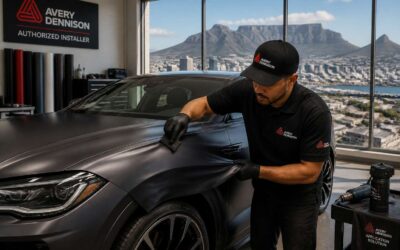
Once the panel is mapped and trimmed, the application begins. The installer loads the film with a slip solution or a dry tack method. A felt squeegee makes the first pass, seating the vinyl without scratching the gloss finish.
The heat gun follows in slow passes. Each section gets worked from the centre outward. The technician’s fingers guide the film into channels and around edges. A soft edge tool tucks the vinyl into gaps where the trim meets the body. I have seen a single door take forty minutes from start to finish.
For a gloss vinyl wrap cape town, the sequence matters:
1. Clean the surface with isopropyl alcohol.
2. Position the film with a hinge tape.
3. Squeegee from the centre to the edges.
4. Heat and stretch around curves.
5. Trim the excess with a fresh blade.
6. Post-heat every edge to lock the adhesive.
The final pass uses a low-tack squeegee to check for lifted edges. The film settles overnight, and the gloss vinyl wrap cape town gains its full depth.
Heat Settling and Edge Wrapping
Heat settling is where the vinyl learns obedience. The film softens under the heat gun, then shrinks as it cools, pulling tight around compound curves. Without this step, your gloss vinyl wrap cape town would lift at the first south-easter.
Edge wrapping is the final act of persuasion. The technician reheats the same edge three or four times, using a soft tool to press the film into the gap where the panel meets the next one. The trick is temperature control. Too much heat and the vinyl thins; too little and it springs back.
A typical edge sequence looks like this:
1. Heat the edge to a gentle tack.
2. Tuck the film with the soft tool.
3. Reheat and press again.
4. Wipe with a low-tack squeegee.
That repeated cycle locks the film into place. The result is a gloss vinyl wrap cape town that survives car washes, heat, and the odd careless door in a parking lot. The edges stay hidden, and the finish stays deep.
Final Inspection and Delivery
Every qualified installer treats final inspection as its own stage. Under direct workshop lighting, the wrapped panels are checked for dust specks, lifting edges, and visible seams. Gloved hands sweep across the surface to detect any slight irregularity the eye might miss. A gloss vinyl wrap cape town only passes if it looks flawless from every angle, including the lower sills and mirror caps.
The handover ritual includes a few essentials:
1. A slow walk around the vehicle to review the finish.
2. A short demonstration of safe washing practices.
3. Confirmation of the warranty terms.
The keys go back to the owner with the film still settling into its final bond. A gloss vinyl wrap cape town needs a few days of calm before it faces the open road.
Caring for Your Glossy Wrapped Vehicle
Hand Washing Techniques and Products
A freshly wrapped car glistening under Cape Town’s summer sun is a sight to behold. That glossy sheen, however, demands a specific ritual to maintain its spell. Water alone will not suffice. The mineral content in municipal supply can leave ghostly deposits on the film’s surface, dulling the very brilliance you paid for.
Hand washing remains the safest method to preserve the integrity of your gloss vinyl wrap cape town investment. You need a gentle, pH neutral soap, specifically formulated for vinyl or automotive use. Mix it in a bucket of lukewarm water, not hot, as extreme temperatures can soften the adhesive. Use a microfiber mitt and work in straight lines, following the contours of the body panels, rather than circular motions which can induce micro marring.
– Use two buckets, one for soapy water and one for clean rinsing.
– Rinse the mitt in the clean bucket before reloading with suds.
– Dry with a soft, plush microfiber towel using a blotting motion.
You must avoid harsh chemicals, abrasive compounds, or even basic dish soap, which strips the protective top coat. Wax and sealants are unnecessary at first. The film has its own inherent properties. Over time, the topcoat will age gracefully, and a dedicated vinyl polish later will renew its depth. For now, clean water and a gentle touch are all you need to keep that reflection sharp.
Dealing with Bird Droppings and Sap
Bird droppings and tree sap are not merely unsightly. They are acidic compounds that can etch the laminate surface of your gloss vinyl wrap cape town finish if left to bake in the sun. A seagull’s deposit on a Sea Point street can burn through the topcoat within hours, and I have seen wraps ruined by a single day of neglect.
Act quickly, but with a steady hand. The standard procedure calls for softening, lifting, and rinsing:
- Lay a damp microfiber cloth over the spot for one minute to rehydrate the deposit.
- Roll the softened residue off with a fresh cloth, using light pressure only.
- Rinse the panel with clean water and blot dry.
For stubborn sap, use isopropyl alcohol diluted to 10% with water. Apply it to the cloth, not the film itself, and work the residue off gently. Avoid commercial bug removers, which often contain solvents aggressive enough to dull the glossy layer.
Maintenance Schedule for Longevity
Wrapped vehicles hold secrets. A gloss vinyl wrap cape town finish follows a hidden timetable, one that ignores calendars and responds to UV exposure, salt air, and temperature swings. Owners who treat maintenance as an event miss the point entirely. The schedule lives in the material.
- Weekly: assess edges and corners where lifting begins, usually near wheel arches.
- Monthly: perform a rinse to remove salt film from coastal drives.
- Quarterly: inspect for oxidation or micro-scratches under strong light.
- Annually: evaluate the laminate thickness around high-wear zones.
This rhythm is not arbitrary. It mirrors the degradation curve of the polymer, which accelerates in Cape Town’s intense sunshine. Regular attention, however brief, keeps the wrap behaving predictably.
When to Consider a Wrap Removal or Replacement
Caring for a glossy wrapped vehicle extends beyond washing. Every film eventually reaches its endpoint, and knowing when to act determines the outcome. Several indicators suggest it is time to remove or replace the gloss vinyl wrap cape town finish. Lifting edges, fading color, and micro-cracks signal that the material’s protective layer has weakened. The wrap serves more than aesthetics. It shields original paint from harsh sun und salt air. When these signs appear, removal prevents adhesive residue und potential damage to the underlying surface. Replacement offers a fresh start, letting you update the vehicle’s appearance without carrying the old film’s flaws. A professional team can evaluate the film’s condition und determine whether removal suffices or a new wrap is needed. They will ensure the surface remains smooth, ready for whatever follows.
Understanding the Investment and Return on Gloss Wrapping
Cost Factors for Cape Town Customers
Cape Town drivers often ask what a gloss vinyl wrap cape town costs, yet the real question is what it returns. A full wrap typically trades against a premium respray, and that comparison shapes the entire investment case. Repaints lose value on originality, while a wrap protects the underlying lacquer and adds a reversible layer of value.
Cost factors fall into three buckets.
- Vehicle dimensions, since a Land Cruiser consumes more film than a Polo;
- trim complexity, such as bumpers, handles, and mirrors;
- labour hours, which vary with installation skill and the facility’s equipment.
These variables explain why quotes in Cape Town range so widely, and why the cheapest option rarely delivers the best return.
Comparison with Traditional Paint Jobs
Spending R20,000 on a temporary colour change sounds absurd until you price a respray that shaves 15% off your car’s resale value. A gloss vinyl wrap cape town changes that calculus. It protects the factory finish, stays removable, and often costs less than a quality paint job. The return isn’t only financial. You get the thrill of a new car without the permanence of a decision made in a paint booth.
Consider what you’re paying for with traditional paint:
- Sanding and masking labour that adds hours to the bill.
- Paints and clear coats that degrade under Cape Town’s sun.
- A one-way commitment that cuts into future resale.
Wrap installation uses precision cutting and heat setting instead. That reversible layer means your original lacquer stays pristine. When you sell, a buyer sees a garage-kept car, not a repainted one. The gloss vinyl wrap cape town market exists because drivers realised the cheaper route often costs more in the long run.
Business Signage and Fleet Branding Advantages
Few marketing tools offer the measurable return of a wrapped fleet. Every kilometre your vehicle travels becomes an impression, and a gloss vinyl wrap cape town service turns that commute into repeated exposure. The upfront spend on signage also protects the bodywork underneath, which matters when you eventually sell or trade the vehicle.
For businesses, the calculation shifts from aesthetics to arithmetic. A gloss vinyl wrap cape town applied to a delivery van or bakkie costs less per lead than most digital ads, and it keeps working outside business hours. No other medium follows your customers to their neighbourhoods.
The real advantage of gloss wrapping for signage is flexibility. Change your contact details, rebrand, or refresh a tired design without committing to permanent paint. That reversibility is the return you cannot measure in rands alone.
Tax Deduction Possibilities for Businesses
For a business owner, the question is not whether a wrap looks good. It is whether the numbers make sense. A gloss vinyl wrap cape town installation is a capital expense with a paper trail. SARS allows you to claim the cost as a deduction when the vehicle is used for trade purposes. That changes the effective price of the wrap.
Consider the return. The wrap protects the paint, which preserves the resale value. It also generates impressions while the vehicle is parked or moving. The deduction reduces the tax burden, and the marketing value compounds daily.
- The full cost is deductible in the year of installation for vehicles used in trade.
- The invoice and proof of payment form the paper trail for the claim.
- The wear and tear schedule for the wrap itself may differ from the vehicle’s schedule.
Every rand spent on a gloss vinyl wrap cape town should be measured against the alternative. Paint is permanent and expensive. A wrap is removable, replaceable, and deductible.



0 Comments