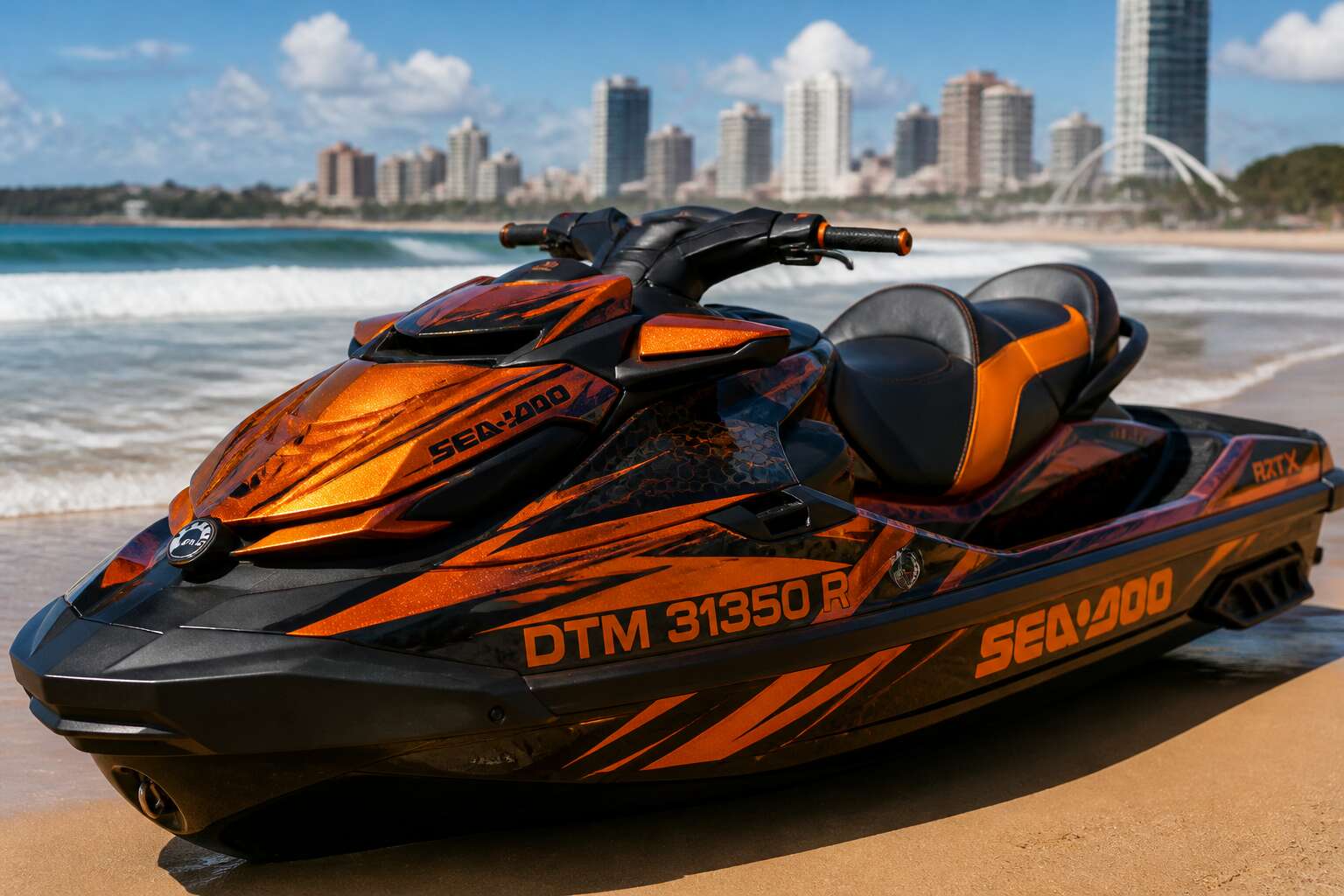
Why Choose a Vinyl Transformation for Your PWC
Protecting Against Coastal Elements
The Indian Ocean off Durban is unforgiving. Salt spray, intense UV rays, and abrasive sand combine to erode a jet ski’s gelcoat within months. That’s why a vinyl transformation is more than aesthetics. It creates a physical barrier that absorbs the punishment.
Consider the process. A marine-grade cast vinyl adheres tightly, sealing out moisture. It resists the oxidation that turns white hulls yellow. For owners who ride weekly, this means less time polishing and more time on the water.
- Ultraviolet inhibitors prevent fading and chalking.
- Self-healing layers reduce scratches from sand and dock contact.
My own experience with jet ski vinyl wrap durban showed me how quickly unprotected surfaces deteriorate. The wrap takes the hit, not the original finish.
Cost-Effective Customization
Custom paint for a PWC can exceed R20,000. A jet ski vinyl wrap durban costs a fraction of that, yet delivers the same visual impact. The choice is not about compromise. It is about redirecting money toward what matters: your riding experience.
Vinyl allows you to own a unique design without the permanence of paint. When your taste changes, or you decide to sell, the wrap peels away. The original gelcoat remains untouched, preserving resale value.
- Lower upfront cost than a respray
- Full design changes in days, not weeks
- Protects the factory finish underneath
That is the quiet logic of wrapping. You invest less, keep the option to change, and walk away with a machine that reflects who you are, not who you were.
Preserving Original Paintwork
Every hull carries a history, but it does not have to be written in permanent ink. A jet ski vinyl wrap durban sits over the original gelcoat like a veil, keeping the factory finish pristine beneath. Paint requires sanding, preparation, and a commitment that cannot be undone. Vinyl is a reversible ritual.
I have seen machines unwrapped years later, and the gelcoat gleams as if the craft had just left the assembly line! That is the quiet magic of a jet ski vinyl wrap durban. The surface stays untouched. The value stays intact.
The wrap bears the brunt of time. Every scrape and scuff is absorbed by the vinyl, not the hull. When you part with the machine, the old skin peels away and the original face is revealed once more. No scars. No evidence. Just the craft as it was born.
A transformation should leave something behind, not take it away.
Enhancing Resale Value
The resale market rewards first impressions. A jet ski that presents well will always draw more serious enquiries than one that looks neglected. A jet ski vinyl wrap durban gives you control over that first image.
We have seen units sell for a premium simply because they looked newer than their years. Buyers purchase what they see. A wrap signals ownership pride and suggests the engine received the same care as the exterior.
Consider what a prospective buyer notices:
- Deep, consistent colour with no fading
- A smooth surface without oxidation patches
- Graphics that look intentional, not worn
These details translate into perceived value. When the time comes to sell, the wrap can be removed to reveal the original gelcoat or kept intact if the next buyer loves the design. Either way, your jet ski vinyl wrap durban has done its job.
Popular Wrap Finishes and Material Choices
High-Gloss Finishes
Gloss levels above 90% reflect nearly all visible light, which explains why high gloss finishes dominate requests for a jet ski vinyl wrap durban. The chosen film, usually a cast polyvinyl chloride, lays a surface that mimics gelcoat without the added weight or expense.
Material choice matters more than the sheen. A thicker film resists stone chips but struggles around tight curves. A thinner cast film conforms well yet demands careful handling. Consider these factors:
- Film thickness affects how tightly the wrap follows hull contours
- Air release channels allow faster, cleaner installation
- Surface texture determines the final reflection quality
I remember wrapping a friend’s Yamaha and watching the gloss change character as the afternoon light shifted! The durban heat tested the film’s tolerance, yet the finish held its depth without softening. That durability comes from the resin’s cross linked structure, not the shine itself.
Matte and Satin Options
Matte finishes skip the mirror effect entirely. They scatter light instead of bouncing it back, so water spots and salt smears take longer to show. For a jet ski vinyl wrap durban, that is a practical virtue. Satin covers the middle ground, offering a soft sheen that resists fingerprints without drawing attention under the Durban sun.
Film choices narrow down quickly. A cast vinyl with a matte topcoat handles hull compound curves better than budget calendered alternatives. I have seen matte wraps handle harbour haze that leaves gloss finishes dulled! Surface texture changes how the wrap catches light, and texture depth varies between manufacturers. Some matte films feel rubbery; satin films feel slick.
- Low grade adhesive on matte films lifts on curved chines.
- Air release channels matter for seat pods.
Metallic and Chrome Effects
Metallic finishes bring a different character to a jet ski vinyl wrap durban. These films contain tiny metal flakes suspended in the vinyl, and those flakes sit at different angles under the clear topcoat. That is why metallics shift tone depending on viewing angle. Chrome effects take it further. Real chrome vinyl uses a vacuum-deposited aluminium layer that reflects nearly all incoming light. It looks striking on the water, yet it does not stretch evenly over compound curves. An experienced installer knows exactly where chrome will wrinkle.
For a jet ski vinyl wrap durban, the base material matters. Silver metallics pop against blue ocean water. White chrome reads as pearlescent. Dark metallic gunmetal hides swirl marks from tight-radius sanding.
A quick comparison of finish behaviour:
- Metallic: soft sparkle, moderate stretch, forgiving
- Chrome: mirror reflection, stiff film, limited stretch
Choose based on the surface area and your intended use.
Carbon Fibre Textures
In the marine industry, true carbon fibre only appears on components where every gram counts. The craft’s hull and deck, however, usually get their woven look from a carefully engineered vinyl film. For a jet ski vinyl wrap durban, carbon fibre textures deliver that race-inspired aesthetic without the composite workshop.
Here is what to expect from different carbon fibre textures:
– Twill weave: the classic 45 degree diagonal pattern, ideal for large flat surfaces
– Forged carbon: a random, splintered look that suits aggressive hull graphics
Most carbon fibre vinyls use a dual layer construction. The base layer provides the dark background, while the top layer carries the embossed weave. Stretching must be done with a heat gun set to the right temperature. Too much heat flattens the weave and leaves a glossy spot.
Colour-Shifting Films
Colour-shifting films are a different breed of wrap. The pigment flakes sit at varying depths in the vinyl, so the hue changes as you walk around the craft. One angle reads deep sapphire, another flashes emerald. For a jet ski vinyl wrap durban, this effect rewards owners who want their machine noticed at the launch ramp.
Material choice affects the result. Cast films hold their colour under tension and wrap around hull curves cleanly. Calendared films are cheaper but stretch unevenly over the sponsons and intake areas. I ask every customer how they use their ski before recommending a film type.
- Chromatic films shift between two colours, such as blue to green
- Spectral films cross several hues and suit full hull coverage
Application demands precision. Each panel must be aligned before heat setting, because the colour shift makes any overlap obvious.
Custom Printed Graphics
Popular finishes include brushed metal films with a fine directional grain and pearl finishes that catch light without shifting colour. Textured films mimic woven fabric or natural stone. Each option changes how the hull reads from the launch ramp.
Custom printed graphics take this further. We print your design directly onto the vinyl, then seal it with a laminate layer. This means a jet ski vinyl wrap durban can carry a business logo, a wave pattern, or anything else you imagine. The image sits beneath the laminate, protected from scratches and salt spray.
The material beneath the print still carries the responsibility. I recommend cast films with air-release adhesive for any custom job. The adhesive lets trapped air escape during installation. The laminate thickness determines how many seasons the print survives.
Popular custom work includes:
- Business logos and fleet branding
- Racing numbers with contrasting shadows
- Full hull photographic prints
What to Expect During the Installation Process
Initial Consultation and Design
Every durable wrap starts with a conversation, not a cut. In Durban, the initial consultation for a jet ski vinyl wrap durban is where your preferences meet the machine’s geometry. A designer maps the hull’s contours, checks for gelcoat damage, and asks how you ride. This dialogue reveals your tolerance for glare, your need for durability, and your appetite for colour.
The consultation covers three essentials.
- The condition of the existing surface, since deep scratches will telegraph through any film.
- Your material choice between cast and calendered vinyl.
- The digital mockup, which projects how each graphic stretches over the hull’s curves.
That mockup is a proof, not a promise. It forces decisions about panel placement and seam visibility. Your sign-off locks down the design before any film is cut, preventing costly revisions.
Hull Preparation and Cleaning
Once the design receives your sign-off, the real transformation begins. The hull enters a wash bay where a high-pressure rinse removes salt residue and grit. A marine-grade degreaser breaks down old wax, engine oil, and the invisible film of grime that accumulates from harbour waters.
Sanding follows. Technicians wet-sand the surface with fine grit to eliminate microscopic peaks and valleys. This creates an ideal surface for the film to bond. A tack cloth wipe-down removes any remaining dust. The ski then moves into a climate-controlled booth where the temperature is stabilised for optimal adhesion.
For a jet ski vinyl wrap durban, the essential preparation steps are:
- Thorough washing and degreasing to expose the bare gelcoat.
- Wet-sanding and contour feathering to smooth every curve.
- Final solvent wipe to ensure a clean, static-free surface.
Precise Application Techniques
Watching the vinyl settle over the curved hull is where the craft truly reveals itself. Our installers begin by laying the film with a slip solution, allowing precise repositioning over the deep channels of the ski. Every contour demands a controlled squeeze from the edge outward, forcing out air and moisture before the adhesive locks.
The process is methodical. For complex recesses, we use a combination of heat and pressure to stretch the film without distorting the print:
– Heat gun set to a low temperature
– Soft squeegee with a felt edge
– Relief cuts at stress points
A meticulous jet ski vinyl wrap durban application takes hours, not minutes. Rushing here would compromise the final finish.
Quality Assurance Checks
Once the film is set, we move into quality assurance. Every panel gets inspected under direct lighting. We look for lifting edges, trapped air, or foreign particles beneath the surface. The seams are the most vulnerable points, so we scrutinize those with extra care.
We then test the wrap’s adhesion along the hull’s stress areas. A precise jet ski vinyl wrap durban installation should feel seamless to the touch. We also verify that all factory openings, such as drain plugs and fuel caps, remain fully accessible. Any misalignment gets corrected on the spot, not after the client leaves.
Our inspection includes these final checks:
- Edge lifting around recessed panels
- Colour consistency across curved sections
- Surface contamination under the film
Only after those checks pass does the ski leave the workshop.
Timeline and Turnaround
Most installs take two to four days. The timeline depends on the hull size, the film complexity, and whether we are doing seam-free panels or custom printed graphics. We give you a firm completion date at the booking stage. That date is realistic, not optimistic.
A jet ski vinyl wrap durban project follows a strict schedule. Day one covers stripping fittings and cleaning. Days two and three are for film application and trimming. The final day is for reassembly and the quality checks we described earlier.
Turnaround times shift based on these factors:
– Hull size and shape
– Film type and installed finish
– Custom print complexity
Once the wrap is complete, the ski stays in the workshop for at least 12 hours. This lets the adhesive cure fully. You collect the ski ready to ride, with no further waiting.
Caring for Your Newly Wrapped Watercraft
Washing Guidelines
The sun never misses a day in Durban. Neither should your washing routine after a fresh jet ski vinyl wrap Durban install. The ocean spray dries into a salty film that pulls at the vinyl edges. Start every wash before the sun bakes that residue into the surface. The first week is critical; the adhesive is still curing, so treat the watercraft with restraint. Use a low-pressure hose, never a pressure washer, which can force water under the seams. Work from the top down with a microfiber mitt and pH-neutral soap. Let the soap dwell for two minutes on waterline stains. Dry with a silicone blade to prevent mineral spots.
Keep these habits in your post-ride rotation:
- Rinse the entire hull with fresh water before the spray dries.
- Wash in the shade, since direct sun dries the soap too fast.
- Blot bird droppings or tree sap immediately, never scrape them.
This ten minute routine keeps the film intact for years.
Protecting Against UV Exposure
Durban’s ultraviolet index often reaches 11, a level where skin burns in minutes. Your jet ski’s vinyl wrap faces a similar assault. The vibrant finish from a professional jet ski vinyl wrap durban installation requires deliberate shelter. A rinse alone cannot stop the solar degradation. The sun’s rays break polymer bonds, fading pigments and urging micro-cracks into the film.
- Store the watercraft under a UV rated cover when idle.
- Apply a marine grade UV protectant every four weeks.
- Moor in shaded spots during peak solar hours.
The adhesive beneath the wrap also suffers. Direct heat slows its cure and reduces grip. One winter afternoon in the Durban sun can shorten the wrap’s life by months. Treat UV as a silent adversary, one that respects no schedule.
Avoiding Harsh Chemicals
A fresh jet ski vinyl wrap durban installation has no shield. Harsh chemicals are its direct enemy. Bleach based hull cleaners, acetone, and brake parts cleaner will etch the film within seconds. One misplaced spray at a petrol station wash bay can leave permanent clouding.
- Avoid petroleum distillates
- Avoid abrasive polishes
- Avoid solvent laden degreasers
Choose pH neutral soap and a microfiber mitt. That simple routine works. I have seen wraps ruined by a single degreaser. Durban humidity amplifies residue, turning compounds into sticky acids. Rinse with fresh water, dry gently, and leave silicone sprays on the shelf.
Seasonal Storage Tips
Durban winter humidity is a constant threat to stored watercraft. Proper seasonal storage protects your jet ski vinyl wrap durban investment. Start by washing the craft with pH neutral soap, then dry every crevice completely. Salt residue left to bake into the film weakens the adhesive over time.
Use a breathable cover, not a plastic tarp. Trapped condensation against the wrap creates mildew, and the bond begins to fail. Store the trailer with wheels chocked and the hull slightly elevated to avoid pressure indentations. Position the watercraft away from direct afternoon sun, as UV rays still penetrate covers.
- Wash and dry before covering
- Loosen tie-downs
- Check for lifted edges monthly
When the watercraft sits for weeks, inspect the edges closely. Early detection of peeling means a simple repair rather than a full reapplication. A little forethought now saves a costly headache later.
Repairing Minor Scuffs
A single scuff undoes a flawless finish. The vinyl absorbs the impact, keeping the gelcoat intact. A scuffed jet ski vinyl wrap durban is not ruined, though. The damage is often minor.
Light abrasions respond to heat. A careful heat gun pass lets the urethane relax and flow back into the mark. Deeper gouges, from a trailer buckle or a concrete edge, demand a scalpel, a clean patch, and patience. Rushing traps air and makes the repair visible.
Culprits are predictable. At our Durban workshop, we see them weekly:
- Ratchet straps left tight during transport
- Dock fenders rubbing in a chop
- Sand ground into the hull during beach launches
Any puncture exposing the gelcoat needs professional care soon. Moisture creeps beneath the film. Quick attention keeps a small fix small. Delaying repairs on your jet ski vinyl wrap durban in Durban’s humidity turns a scuff into a full reapplication!
When to Re-Wrap
After application, the adhesive keeps curing for days, sometimes longer in Durban’s humidity. Fresh edges stay vulnerable to lifting around sharp curves and recessed handles. A jet ski vinyl wrap durban performs best when treated gently during this period. Heat accelerates the bond, but so does letting the craft bake after a ride. Over time, the film’s depth fades almost imperceptibly until the original vibrance is gone. That is when a rewrap becomes necessary.
Common signs the vinyl has reached the end of its life:
- Fading that resists polishing
- Lifting edges that return after heat setting
- Fine cracks across the film surface
- Colour shift between original and patched sections
Waiting beyond these signs risks the gelcoat beneath, defeating the protection entirely.
Finding the Right Wrapping Experts in the Coastal City
Reviewing Local Portfolios
When searching for a jet ski vinyl wrap durban, the first step involves proof, not price. Local portfolios tell a story of real work performed under coastal conditions. Reviewing them requires attention to seams, edges, and how the film wraps around curved hull sections. A quality install hides transitions; a mediocre one reveals them.
Ask to see examples of watercraft similar to your own model. Check for colour consistency across different lighting. Look for signs of lifting or bubbling in photos taken after weeks of use. Some installers include close-up shots of nozzle areas, handles, and recessed footwells. Those details matter more than flashy design mockups.
Also consider:
– How long the installer has worked in Durban specifically
– Whether they document their preparation process
– If they offer references from other jet ski owners
Experience in the coastal city often shows up in small choices, such as which edge sealing method they prefer. Let the portfolio guide your decision.
Asking About Warranty Coverage
A warranty is not a formality. In Durban’s humidity, adhesive bonds face daily stress. Ask what happens if a seam lifts after three months. A reputable installer answers with specifics, not vague promises. For any jet ski vinyl wrap durban, insist on written coverage that names edge lifting, fading, and bubbling.
Finding the right wrapping experts in the coastal city takes patience. Visit their workshop. Examine how they store film and prep hulls. Ask about their supplier and whether they use marine grade laminates. A solid warranty reflects confidence, but only if the installer backs it with service. Consider these questions:
- Who handles the claim process?
- What is covered if salt water penetrates?
- How long do repairs take?
The answers separate professionals from weekend tinkerers. Settle for nothing less than clarity.
Verifying Experience with Marine Vessels
Marine environments expose inexperience quickly. A wrapper who has only worked on hatchbacks cannot anticipate how salt spray and flexing fibreglass will treat a hull over time. Demand evidence of work on actual watercraft, not just showroom cars with straight panels.
Visit the workshop and ask to examine a jet ski vinyl wrap durban project mid-install. Look closely at how seams are handled around drain plugs, footwells, and the ride plate. Installers who truly understand marine vessels will point out where moisture tends to collect and which films handle constant immersion without lifting.
Ask these questions before committing:
- How many personal watercraft have they wrapped this season?
- What preparation do they perform specifically for marine gelcoat?
- Which areas of the hull have caused problems in their past projects?



0 Comments